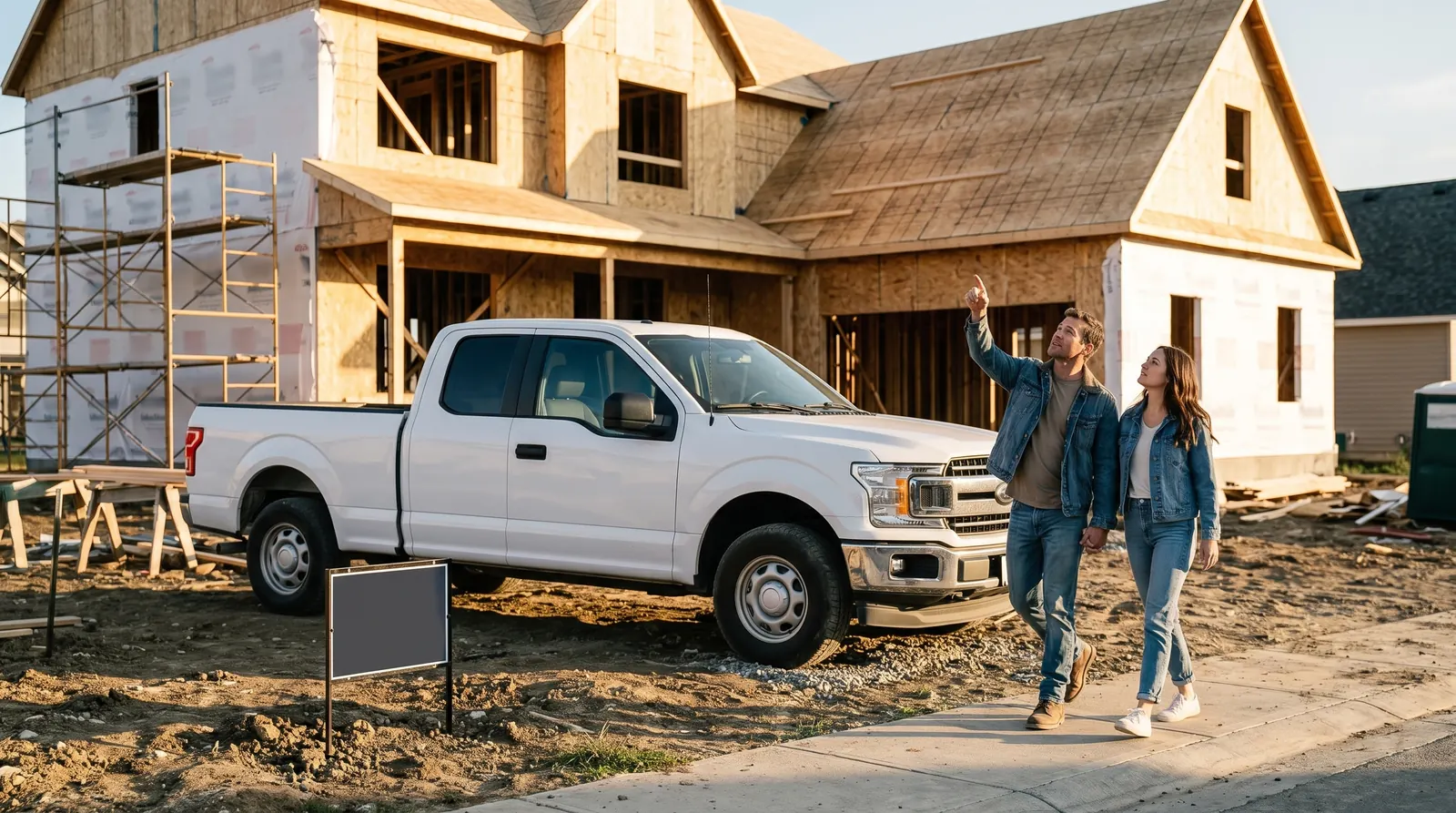
Most construction marketing advice is written by marketers for marketers. Brand stories. Content calendars. “Engagement.” You build houses, remodels, pools or metal buildings. You need the phone to ring with people who are ready to build, in the months you need the work.
Here’s the plain version: a one-page plan, the 6 pieces that bring in jobs, how to measure them, and 20 ideas that cost little.
What construction marketing is for
Marketing has one job: get the right people to call you, at the right time of year, often enough to keep your crews busy.
That breaks into three problems:
- Get found. People who need what you build see your name when they look.
- Get picked. When they compare you to two other builders, you look like the safe choice.
- Get the call back. When they reach out, you answer fast and sort the real buyers from the dreamers.
Most builders only pay for the first one. They buy ads, the leads sit in an inbox for two days, and the ads “don’t work.” Often the ads were fine and the problem was steps 2 and 3. In a Harvard Business Review audit of 2,241 U.S. companies, 23% never answered their web leads at all. In separate data on 1.25 million leads in the same article, firms that called back within an hour were nearly 7 times as likely to have a real conversation with a decision maker as firms that waited longer.
“Fix the call back before you pay for more leads.”
A one-page construction marketing plan
You don’t need a 30-page plan. You need one page that answers six questions:
| Line | The question it answers |
|---|---|
| Goal | How many signed jobs do you need, and by when? |
| Lead math | How many leads does that take, working backward from your close rate? |
| Channels | Where will those leads come from? |
| Budget | What will you spend per month, and what is a signed job worth? |
| Calendar | When does each thing start, so leads arrive before the slow months? |
| Owner | Who does each task every week, by name? |
The lead math works backward:
- Appointments needed = jobs needed ÷ close rate (appointments to signed)
- Qualified leads needed = appointments ÷ booking rate (qualified leads that book a meeting)
- Total leads needed = qualified leads ÷ qualified rate
Don’t know your rates? Count last year’s leads and signed jobs. Rough numbers beat guessing.
Worked plan: a small custom home builder
Say you build custom homes and want 6 signed next year. You close about 1 in 3 site meetings. About half of qualified leads book a meeting. About 1 in 3 leads is qualified (owns land or is buying it, has a budget that fits, wants to start within a year).
6 jobs ÷ 1/3 = 18 meetings. 18 ÷ 1/2 = 36 qualified leads. 36 ÷ 1/3 = 108 leads a year, about 9 a month.
| Line | Hypothetical custom builder plan |
|---|---|
| Goal | 6 signed homes, contracts by next September |
| Lead math | 108 leads, 36 qualified, 18 meetings, 6 signed |
| Channels | Google profile and reviews (aim for 3 to 4 leads a month), referrals from past clients, realtors and a lender (1 to 2), Google search ads (3 to 4), Meta ads showing finished homes (1 to 2) |
| Budget | Say ads produce 50 leads a year at $150 each: $7,500 in ad spend, about $1,250 per signed home. Plus website and your time |
| Calendar | Ads on from October to April, when your buyers plan. Reviews and photos all year |
| Owner | You: site meetings. Office manager: reviews, photos, posts, follow-up texts |
Worked plan: a remodeler
Say you do kitchens, baths and additions and want 24 jobs next year. You close 1 in 3 in-home estimates, 60% of qualified leads book one, and 40% of leads are qualified.
24 ÷ 1/3 = 72 estimates. 72 ÷ 0.6 = 120 qualified leads. 120 ÷ 0.4 = 300 leads a year, 25 a month.
| Line | Hypothetical remodeler plan |
|---|---|
| Goal | 24 signed jobs, 2 a month |
| Lead math | 300 leads, 120 qualified, 72 estimates, 24 signed |
| Channels | Google profile and reviews (8 a month), Local Services Ads (6), Google search ads (6), referrals and repeat clients (3), Meta ads (2) |
| Budget | Say 14 paid leads a month at $90 each: about $1,260 a month, $15,120 a year, about $630 per signed job |
| Calendar | Ads on all year, budget up 2 to 3 months before your slow season |
| Owner | Owner: estimates. Lead coordinator: answers every lead within 5 minutes, books estimates, sends follow-ups |
Those numbers are made up to show the arithmetic. Put in your own.
Do the math1minute,free Calculator No email neededHow many leads do you need?Try the leads calculator →
The 6 pieces of construction marketing
Every builder marketing plan is some mix of these six. Do them roughly in this order.
1. Your website
What it does: Every other piece sends people here.
What good looks like: Phone number at the top of every page. A first screen that says what you build and where. Real job photos. A page per service and per main town. Your license number. A form that asks about land, budget and timing and texts every lead to your phone.
How to do it:
- Change the first screen to: “Custom homes in [town] and [town]. Call (555) 555-0100.”
- Add one page per service with 10 or more of your own photos.
- Replace “Name, Email, Message” with 4 to 6 qualifying questions.
Time and money: A fix-up is a weekend or two yourself. A new site runs from a site-builder subscription plus your time to a paid build. Full blueprint: contractor website design.
2. Google Business Profile
What it does: It’s your listing in the map results. For many builders it brings more calls than the website.
What good looks like: The right primary category, your service area, real hours, 30 or more job photos, a link to your site, and new photos every month. Google says local results are based mainly on relevance, distance and prominence. You can’t change distance. You can change the other two.
How to do it: Claim or verify the profile, fill in every field, add 10 photos this week and 4 a month after. Step-by-step in Google Business Profile for contractors.
Time and money: Free. About 2 hours to set up, 20 minutes a week after.
3. Reviews
What it does: Reviews decide who gets picked. 40 recent reviews often beat a better builder with 6 old ones.
What good looks like: New reviews every month that mention the job and the town, each with a reply from you.
How to do it: Get your review link from your Business Profile: Read reviews, then Get more reviews, then copy the link (Google’s steps). Text it at the final walkthrough. Ask everyone, not just the happy ones: Google’s policy bans “review gating,” offering anything in return for a review, and pressuring customers (Google’s policy).
Hi [name], it was good working on your [kitchen]. If you have 2 minutes, a Google review helps other people in [town] find us: [link]. Thank you, [your name]
Time and money: Free. 5 minutes per finished job. More scripts in how to get more Google reviews.
4. Search (SEO)
What it does: It gets you on page 1 for “home builder [town]” without paying per click.
How to do it: Write one service page a month (600 to 1,200 words, your own photos, a clear next step) and one town page a month for the towns with your best jobs. Full guide: SEO for contractors.
Time and money: Mostly time. Expect months, not weeks, before it shows. It keeps working after you stop paying.
5. Ads
Ads are the only piece you can turn up when you need work next quarter. Three kinds matter for builders.
Google search ads. Your ad shows when someone searches “custom home builder [town].” You pay for each click, whether or not they call. Start with 10 to 20 keywords for your main service and town. Add negative keywords on day one so you don’t pay for searches like “jobs,” “salary,” “DIY,” “plans free,” and “Home Depot.” Send each ad to the matching service page, not your home page.
Local Services Ads. You pay per lead, not per click, and leads Google judges invalid aren’t charged. In the U.S. and Canada you can dispute certain charged leads within 30 days, at Google’s discretion (Google’s page). They’re available only for certain business categories, so check whether yours is listed.
Meta ads (Facebook and Instagram). These show your work to people nearby before they search. Use real job photos and short walkthrough videos, and send people to a short quiz. One catch: if your ad is about a housing opportunity, such as a spec home for sale, Meta requires the Housing special ad category, which blocks age, gender and ZIP code targeting and sets a minimum 15-mile radius in the U.S. and Canada (Meta’s documentation). Check with Meta’s help center whether your ads fall under it.
Lead sites (Angi, Thumbtack, Houzz, Yelp) are a fourth option, with trade-offs covered in lead sites for contractors.
Time and money: Ad spend plus 1 to 3 hours a week to watch search terms, pause waste and answer leads. Set the number with the ad budget calculator.
6. Follow-up
What it does: It turns leads you already paid for into jobs.
What good looks like:
- Every form and missed call gets a text back within a minute.
- A real person calls within 5 minutes during work hours.
- Every bid gets follow-up on day 1, 3, 7, 14 and 30.
- “Not yet” leads get a check-in every month or two.
Hi [name], this is [you] with [company]. Got your request about the [project]. Is now a good time for a quick call, or is later today better?
A note on texting: business texting from software on a regular 10-digit number generally requires A2P 10DLC registration with the carriers. Replying to someone who just called or filled out your form is different from texting a list. Marketing texts need prior consent.
Time and money: A text-back tool’s monthly fee, plus 15 minutes a day. Wording: bid follow-up scripts. Setup: speed to lead for contractors.
Brand basics that actually matter for builders
You don’t need a brand strategy. You need a name people recognize, used the same way everywhere.
- Name. Use your real business name everywhere. On your Google profile, adding service or location words that aren’t part of your real name isn’t allowed and can get the profile suspended (Google’s guidelines).
- Logo. One simple logo that reads from 50 feet: on a truck door, a yard sign, a shirt. Two colors at most. If it doesn’t work in black and white, simplify it.
- Truck. Your name, what you build, your phone number and your website, big enough to read at a stop light. Check your state’s rules. In California, for example, most contractors must show their business name and license number on commercial vehicles in at least 72-point type (letters 3/4 inch high and wide), and the license number must be in all advertising, including websites (CSLB).
- Yard signs. On every job, with the client’s permission. Name, trade and website. Check local sign rules and HOA rules first.
- Job-site signs. A larger sign on new builds with your website. Keep the site clean. A messy site with your sign on it is an ad too.
- Uniforms. Matching logo shirts for anyone on site. Neighbors ask who’s building.
How to set up a referral program
Referrals are often your best leads. Don’t leave them to chance.
Who to ask:
- Past clients from the last 5 years.
- Realtors who sell land or older homes in your area.
- Lenders who do construction loans.
- Architects, designers and engineers.
- Your own subs and suppliers.
When to ask: At the final walkthrough, at the 1-year warranty visit, and any time a client sends a nice text.
What to offer: A thank-you gift for a referral that turns into a signed job is common: a gift card, a dinner, a donation to their charity. Tell them up front. Two rules to keep it clean. First, never offer anything for a Google review. That breaks Google’s policy. Second, some states have licensing rules about paying people for referrals. Check with your state licensing board before you offer cash.
Scripts:
Hi [name], it was a pleasure building with you. Referrals from people like you mean a lot to us. If a friend or neighbor is thinking about [building/remodeling], I'd be glad to talk with them. If they sign with us, we'll send you a [$X gift card] as a thank-you.
Hi [realtor name], I'm [you] with [company]. We build custom homes in [area]. When a buyer asks about building on land, I'm happy to do a free 20-minute call to give them a realistic budget and timeline. Can I send you a few of our recent homes?
Keep a list of who referred whom. Send the thank-you the week the contract is signed.
A seasonal construction marketing calendar
This is for a builder whose work slows in winter. Leads take time to turn into jobs. If your buyers call 4 to 6 months before they start, spring work comes from fall and winter marketing. Shift the months to fit your trade. The slow season forecast shows when your gap will hit.
| Month | What to do |
|---|---|
| January | Raise ad budgets. Follow up every open bid and “not yet” lead |
| February | Book design meetings for spring starts. Write two service pages |
| March | Ask every recent client for a review. Order yard signs and job-site signs for the season |
| April | Spring starts. Keep ads and review asks running |
| May | Before-and-during photos on every job. Post weekly |
| June | Check the numbers so far. Cut what isn’t producing |
| July | Ask realtors and lenders for coffee. Update town pages |
| August | Set the fall ad budget. Add this season’s photos to your site |
| September | Turn ads up for buyers planning next year. Send the past-client note |
| October | Review push: every job finished this year. Send referral thank-yous |
| November | Keep ads running. Follow up every open bid before the holidays |
| December | Past-client note. Write next year’s one-page plan |
If you’re slow every February, it’s usually a calendar problem, not a market problem: the marketing that would have filled February had to start in the fall.
How to measure construction marketing
Track these six numbers monthly in a spreadsheet, with the source of each lead.
| KPI | Formula | Why it matters |
|---|---|---|
| Leads | Count of new calls, forms, texts and messages | Shows if enough people are reaching you |
| Qualified rate | Qualified leads ÷ total leads | Shows if you’re reaching the right people |
| Response time | Average minutes from lead to first real reply | The fastest fix for most builders |
| Appointments | Site meetings or estimates booked | Shows if you turn talk into meetings |
| Close rate | Signed jobs ÷ appointments | Shows if your bids and follow-up work |
| Cost per signed job | Total marketing spend ÷ signed jobs | The only cost number that matters |
Say you spent $3,000 last month, got 30 leads, and 2 signed. Cost per lead is $100, which sounds high. Cost per signed job is $1,500 on $50,000 jobs. That’s cheap. A source that gives 60 leads for the same $3,000 but only 1 signing costs $3,000 per job: twice as much.
20 low-cost construction marketing ideas
- Text old leads. Every lead and bid from 2 years: “Still planning the [project]?”
- Yard signs on every job. With your website, not just your number.
- Photos on every job. Before, during, after, same spot. Post one a week.
- Reviews at the walkthrough. Text the link before you leave the driveway.
- One page per town. Start with your best 3 towns.
- One page per service. Not one “Services” page.
- Yearly past-client note. A card in December with a photo of their project.
- Join the builders’ association. Sit with people you don’t know.
- Two realtors and one lender. Offer buyers a realistic budget call.
- Answer in local groups. Facebook and Nextdoor. Help, don’t pitch.
- Letter your truck. Name, trade, phone, website, license number.
- License and insurance on your site. People check.
- Post on your Google profile. One job photo with the town, weekly.
- Neighbor door hangers. At job start, 10 nearby doors: “We’re building at [street] this spring.”
- Open house on a finished build. With the owner’s OK. Invite neighbors and realtors.
- 60-second walkthrough videos. Shot on your phone. Post everywhere.
- A slow-season offer. “Book a winter design meeting for a spring start.” A date, not a discount.
- Answer the top 10 questions. A page on cost, timeline, land and financing.
- Tag your subs in project posts. They share, and their followers see your work.
- Fix your voicemail. “Text this number and we’ll reply within the hour.” Then do it.
DIY or hire a construction marketing agency?
Do it yourself if you have 3 to 5 hours a week and will stick with it. Most of this is free.
Hire it out if it isn’t getting done. Hire one team that owns the result, not one person for the website, another for ads and a nephew for Facebook.
Questions to ask an agency:
- How many contractors in my trade do you work with?
- What will you report each month: leads, qualified leads, cost per lead, or signed jobs?
- Who answers my leads, and how fast?
- Is the ad spend separate from your fee? Can I see the ad account?
- How long is the contract, and what happens when I leave?
- Who writes the website copy and takes the photos?
Red flags:
- They promise page 1 of Google by a date.
- They won’t give you admin access to your own ad accounts.
- Reports full of impressions and clicks, nothing about calls or jobs.
- A long contract with no way out if leads don’t come.
- They build the site on a platform you can’t take with you.
What you should own:
- Your domain. Registered in your name, with your email as the contact. ICANN says the registrant is responsible for keeping that contact information accurate (ICANN).
- Your Google Business Profile. You as primary owner, the agency as a manager. A profile can have only one primary owner (Google).
- Your Google Ads account. You as an admin. Admins control access and billing (Google).
- Your Meta ad account. In your own business portfolio, with the agency added as a partner (Meta).
- Your photos, website files and lead list.
Common construction marketing mistakes
- Buying leads before fixing follow-up. If leads wait a day, more leads won’t help.
- Turning ads on when you’re already slow. Start 2 to 3 months before the gap.
- Judging by cost per lead. Judge by cost per signed job.
- Asking only happy clients for reviews. That’s review gating, which Google doesn’t allow. Ask everyone.
- Not tracking where leads come from. Ask every caller “How did you find us?” and write it down.
- Splitting work across three vendors with no one responsible for signed jobs.
Frequently asked
How much should a construction company spend on marketing?
There’s no single right number. Work backward from the jobs you need, the leads that takes, and what a lead costs in your area. Then check that cost per signed job is a small share of what a job is worth.
What is the best marketing for a general contractor?
For most general contractors it’s a strong Google Business Profile, steady reviews, and fast follow-up, in that order, then ads to fill gaps. Referrals from past clients, realtors and architects are often the best leads, so make asking for them a habit.
How do construction companies get clients?
Referrals, Google search, the map listing, ads and lead sites. Track the source of every lead for 3 months and you’ll know which works for you. More in how to get construction leads.
What’s a good marketing plan for a small construction business?
One page: the jobs you need, the lead math, 2 or 3 channels, a monthly budget, a calendar that starts before your slow season, and a named person for each task. Review it every month against signed jobs.
How long does construction marketing take to work?
Ads and fixing your follow-up can bring results in weeks. Your Google profile and reviews build over a few months. SEO takes months. That’s why you start before you’re slow.
Is digital marketing worth it for a construction company?
When someone hears your name, even from a friend, they can look you up in 10 seconds. If your site, Google profile and reviews look thin, you can lose jobs you never hear about. Start with the free pieces and add paid ads once follow-up is fast.
If you’d rather hand the whole plan to one team with a lead guarantee, here’s how Get Fully Booked works.