Short answer
Custom home builders get most clients from referrals and from the people buyers meet before they pick a builder: land agents, construction lenders, architects and designers. Add a Google profile with steady reviews and a website with honest cost and process pages, then qualify every lead on land, budget, financing, plans and timeline. Show up at each stage of the buyer's long timeline, not just at the bid.
Custom home builders get most clients through referrals and through the people a buyer meets before they ever call a builder: the agent who sold them land, the lender who approves the construction loan, the architect or designer drawing the plans. Online, the buyer checks your Google profile, reviews and website many times over months, so the builders who stay booked show up at every stage of that long timeline, not only when plans go out for bids.
The short version
- A custom home buyer shops over many months, often longer, in stages: dreaming, land, lender, plans, bids, signing. Each stage has different people and different searches. Show up at each one.
- Your best sources, in order for most custom builders: past clients and referrals, land agents, construction lenders, architects and designers, your Google profile and reviews, your website, then ads.
- Your website needs pages most builders skip: what it costs to build in your area, your process step by step, building on the buyer’s land, and financing.
- Qualify every lead on five things: land, budget, financing, plans, timeline. Call the ready ones first. Keep the rest warm.
- A paid design or preconstruction phase filters out shoppers and pays for your time. It also loses some buyers. Know the trade-off before you switch.
- Contracts lag inquiries by months. A builder who wants 6 homes a year needs a pipeline that started 6 to 9 months before the year.
How do custom home buyers actually shop?
Most builders picture the buyer showing up with plans, land and a loan, ready to sign. That’s the end of the story. The buyer has been at it for a year or more by then, and most of the decisions that matter for you got made earlier.
Here’s how it usually goes:
- Dreaming. They’re tired of looking at existing homes that don’t fit. They save photos, drive through neighborhoods, tour model homes and look up “cost to build a house” in their county. They don’t call anyone yet.
- Land. They look at lots or acreage, or they already own family land. They talk to a land agent. They wonder if the lot will perc, how much site work it needs, and whether they can get power and water to it.
- Lender. They find out a construction loan isn’t the same as a regular mortgage. The lender asks about plans, a builder and a budget. Many buyers learn here that their budget is off.
- Plans. They buy a stock plan, hire a designer, or work with an architect. Some ask a builder to help with this.
- Bids. They send plans to 2 to 4 builders. They read reviews, call references and compare proposals that are hard to compare.
- Signing. They pick a builder, close the construction loan, and sign.
The lender matters for you more than most builders think. On one common loan type, the single-closing construction-to-permanent loan described in Fannie Mae’s Selling Guide, the lender manages paying the loan money out to the builder, and the loan converts to a regular mortgage when construction is done (as of October 2026). The lender is going to pay you. They care who the builder is.
The builder who’s present in stages 1 to 4 is often the only builder at stage 5. That’s the whole game.
The buyer timeline map
This is the core of this guide. It’s our framework, built from how custom home buyers move from idea to contract. For each stage, it shows what the buyer is doing, where you should be, and what you should offer them at that moment.
| Stage | What they search and do | Where you should show up | What to offer |
|---|---|---|---|
| 1. Dreaming | “cost to build a house in [county]”, “custom home vs buying”, “home builders near me”. Save photos. Tour model homes and Parade of Homes. Drive neighborhoods | Your Google profile with lots of photos. A cost page on your website. Facebook and Instagram posts of finished homes and homes in progress. Parade of Homes or a past client’s open house | An honest cost range for your area, from your own past homes. A “how building works” page. A way to get updates without a sales call |
| 2. Land | “land for sale [county]”, “build on my land”, “how much does site prep cost”, “perc test”. Talk to land agents. Walk lots | Land agents who sell lots and acreage in your area. A “build on your land” page. Search ads on land-related searches | A lot walk or site review before they buy. A checklist: access, slope, septic or sewer, power, water, setbacks, restrictions |
| 3. Lender | Call banks and credit unions about construction loans. Get pre-approved. Learn what the lender needs from a builder | Construction lenders’ lists of builders they’ve worked with. A financing page that names lenders you’ve closed with | A preliminary budget they can bring to the lender. A plain explanation of draws and how payments work |
| 4. Plans | Buy stock plans. Hire a designer or architect. Ask “how much will this plan cost to build” | Architects and designers who refer builders. Your plan gallery with square footage and a price range | A plan review for buildability and budget. A paid design or preconstruction agreement |
| 5. Bids | Send plans to 2 to 4 builders. Search “[your company] reviews”. Call references. Compare proposals | Google reviews. Past-client references ready to take a call. A clear proposal | A proposal that explains allowances, what’s included and what’s not, and a timeline. A visit to a home under construction |
| 6. Signing | Compare contracts. Close the construction loan. Pick a start date | Your phone, same day. The lender’s checklist | A contract walk-through. A draw schedule that matches the lender’s. A start date you can keep |
How to use the map
Go row by row and score yourself honestly: present, weak, or missing.
If you’re like a lot of builders, you’re strongest in row 5 (you bid well) and weak or missing in rows 1 to 3. That means they only meet buyers who are already comparing builders on price. The builders who meet buyers at the land and lender stage often don’t compete on price at all, because they’re the only builder the buyer has talked to.
Pick the one missing row with the most buyers in your area and fix it first. For most rural and suburban builders, that’s row 2 (land agents) or row 3 (lenders).
Where do custom home builders get clients? The sources ranked
This ranking is our judgment for a typical small custom builder doing 3 to 15 homes a year. Your area may shift the order. We rank by how likely a lead from that source turns into a signed home, not by how many leads it sends.
1. Past clients and referrals
Your past clients know people who want to build. They’re also your references in stage 5.
What to do:
- Keep a list of every past client with their move-in date.
- Text or call on the move-in anniversary. Ask how the house is holding up. Fix what needs fixing.
- Ask directly once a year: “If you know anyone thinking about building, I’d be glad to talk to them.”
- Ask every past client for a Google review. Ask all of them, not only the happy ones. Google doesn’t allow review gating or rewards for reviews. See how to get more Google reviews.
Hi [name], it's [you] with [company]. Hard to believe it's been [2] years in the house. Anything need a look before winter? Also, if anyone you know is thinking about building, I'm happy to walk their land with them, no charge.
2. Land agents and realtors who sell land
A buyer looking at lots has a question no listing answers: “What will it cost to build here?” You can answer it. That makes you useful to the agent, because a buyer who knows they can afford to build is a buyer who closes on the lot.
- Find the agents with the most land and acreage listings in your area. Look at listing sites and the signs on the lots you drive past.
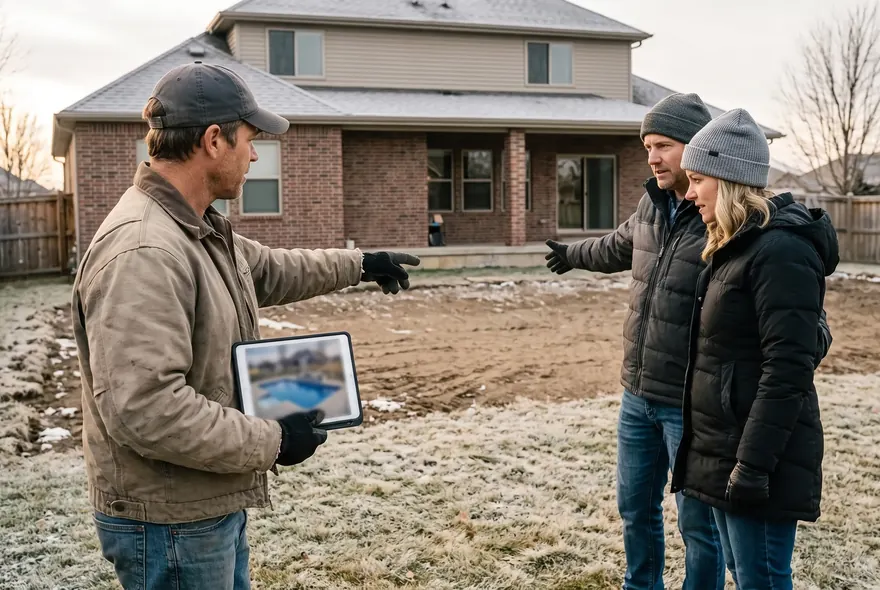
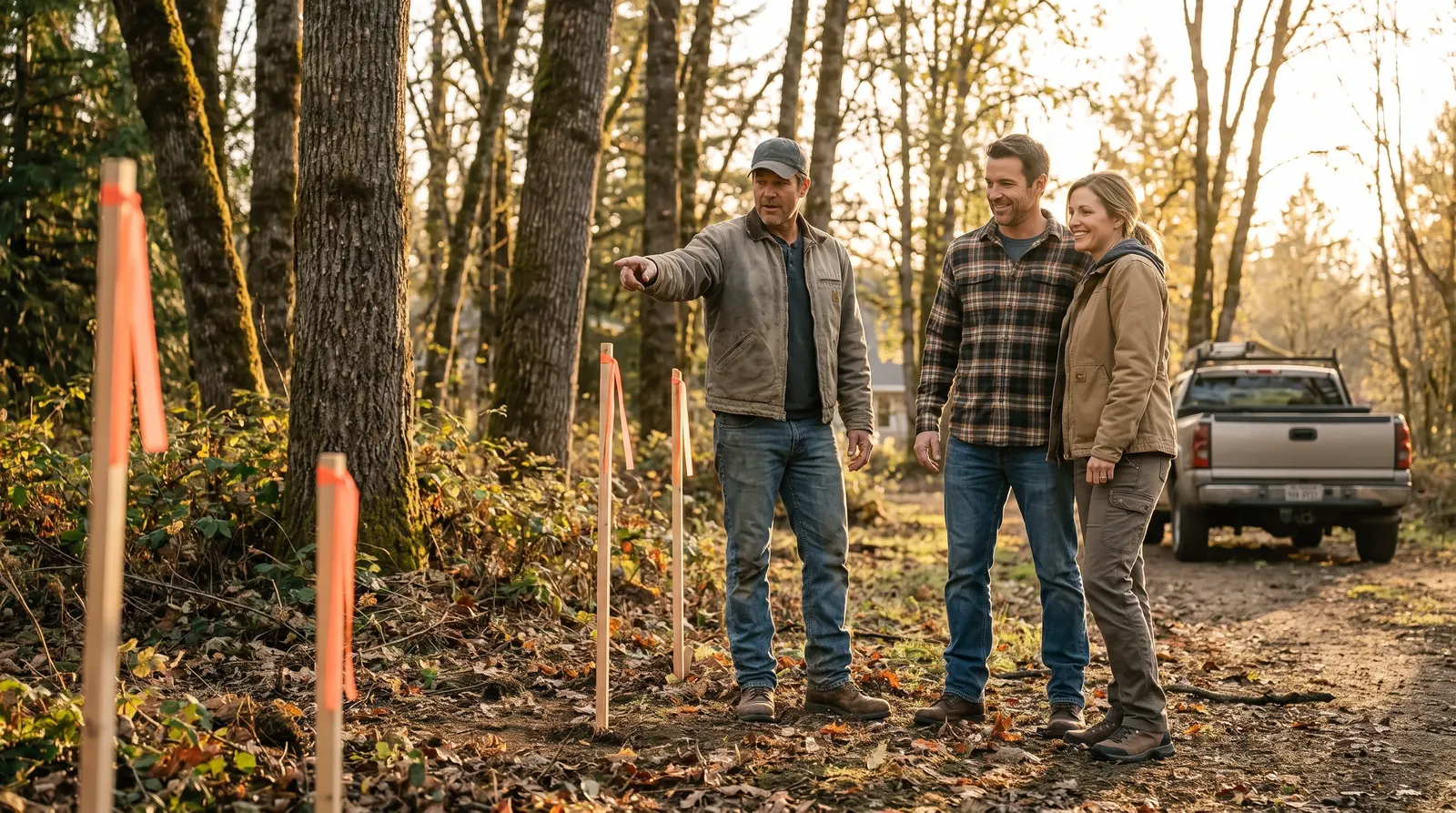
- Offer a lot walk for their buyers within a few days, with a written note on what you saw: access, slope, septic or sewer, power, water, likely site costs.
- Text the agent after every lot walk so they know you showed up.
Rules on paying or receiving referral fees vary by state and license type, especially for real estate agents. Check with your state before offering money. Most agents mainly want their buyer to close.
Hi [name], I'm [you] with [company]. We build custom homes in [county]. When your buyers look at lots, I'm glad to walk the land with them within a few days and send a short note on site costs. Could I show you a couple of our recent homes?
3. Construction lenders
Every buyer who isn’t paying cash ends up at a lender. Some lenders keep a list of builders they’ve closed loans with. You want to be on it.
- Call the construction loan officers at 3 to 5 local banks and credit unions. Ask what they need from a builder to close a loan smoothly. Then have it ready every time.
- Be easy to work with on draws: submit clean draw requests, keep the job on schedule, return calls.
- Send them buyers too. When a lead needs financing, send them to a lender you trust.
Hi [name], I'm [you] with [company]. We build [6 to 8] custom homes a year in [area]. I'd like to make sure we give your team everything you need on our loans. Do you have 15 minutes this week so I can ask what makes a builder easy to work with for you?
4. Architects and designers
A buyer with an architect has already committed time and money. These are some of the most serious leads you’ll get. Architects want builders who build what they drew, price honestly and don’t trash their plans in front of the client.
- Meet the residential architects and designers in your area. Bring photos of homes you built from someone else’s plans.
- Offer a buildability and budget review early, before plans are final. It saves their client from a redesign after bids come back high.
- Never redesign their work without them in the room.
5. Your Google Business Profile and reviews
Buyers look you up many times over months. Your Google profile is often what they see first. Google ranks local results mainly on relevance, distance and prominence (Google), and reviews feed prominence.
- Post photos of homes in progress, not only finished ones. Slab, framing, dry-in, trim-out. It shows you build, not just sell.
- Get reviews from every client at move-in, and again at the one-year walkthrough.
- Answer every review, good or bad.
Full setup: Google Business Profile for contractors.
6. A website with cost and process pages
Your website does the selling between meetings. Most builder sites show a gallery and a contact form. That isn’t enough for a buyer who’s going to spend a year deciding. The section on what to put on the website, below, lists the pages.
7. Model homes and open houses, with the owner’s permission
If you don’t build specs, a client’s finished home is your model. Ask the owner whether you can hold a short open house before they move in, or after with their blessing.
- Ask early, ideally when you sign the contract, so it’s not a surprise.
- Set limits: one afternoon, two or three hours, you on site the whole time, shoes off, no photos of personal items.
- Invite your land agents, lenders, architects and past clients, plus anyone on your lead list who’s in stages 1 to 4.
- Thank the owner in a way they’ll appreciate, and keep it separate from any review request.
8. Parade of Homes events
A Parade of Homes is a home tour run by a local home builders association (HBA). Builders enter newly built homes and the public tours them, at one site or scattered across an area. The National Association of Home Builders’ Parade of Homes toolkit for local HBAs covers ticket sales, sponsorships, entry forms and contracts for participating builders, and awards for builders. Formats, fees, dates and whether you must be a member vary by association. Call your local HBA.
Is it worth it? It depends on whether you have a home finishing at the right time, what the entry costs, and whether the people touring are your buyers. A Parade puts you in front of stage 1 dreamers in large numbers. Most won’t build for a year or more. Have a way to capture their name and what they’re planning, and a plan to follow up for months, not days.
9. Ads aimed at people with land
Ads come last on this list for most custom builders, not because they don’t work but because they work best on top of the sources above. An ad that sends someone to a builder with 6 reviews and no cost page wastes money.
- Google search ads. Target searches that mean land and intent: “build a house on my land [county]”, “custom home builder [county]”, “cost to build a house in [county]”. Send clicks to a “build on your land” page with a short quiz, not your home page.
- Facebook and Instagram ads. Show homes in progress and finished homes, with a form that asks about land, budget and timing. In the U.S., Meta requires housing ads to be declared as a Special Ad Category with approved targeting options (Meta ad standards). Check whether your ads fall under it when you set up the campaign, as of October 2026.
- Mail to recent land buyers. Many counties make recorded deeds searchable. Some builders mail a short letter to people who recently bought vacant land in their area. Check what your county offers and follow the rules for marketing mail where you are.
For budget math, see how much should a contractor spend on marketing.
What about lead sites?
Lead sites send the same request to several builders. For custom homes, where the buyer is choosing someone for a year-long project, a shared lead is a hard place to start. Some builders get work from them anyway. Judge them by cost per signed home, not cost per lead. More in lead sites for contractors.
How do you qualify custom home leads?
Most custom home inquiries aren’t ready to build. That’s normal. The goal isn’t to throw them out. It’s to know which ones to call today and which ones to keep warm for a year.
Ask about five things. Put the questions on your website form or quiz, and ask them again on the first call.
| Factor | Ready now | Getting close | Not yet |
|---|---|---|---|
| Land | Owns it, or under contract | Has picked a lot or area, making an offer | Still looking, or “we’d like a few acres someday” |
| Budget | Has a total number that fits your homes, including land and site work | Has a number, but hasn’t checked it against costs in your area | No number, or a number far below what you build for |
| Financing | Pre-approved for a construction loan, or paying cash | Has talked to a lender | Hasn’t talked to anyone |
| Plans | Has plans, or ready to start a design phase with you | Has a stock plan or ideas to adapt | Only photos and a wish list |
| Timeline | Wants to start within 6 months | 6 to 12 months | 12+ months, or “after we sell our house” with no listing yet |
How to sort:
- 4 or 5 “ready now”: Call today. Book a meeting or lot walk this week.
- Mostly “getting close”: Call within a day. Help them finish the missing step: send them to a lender, walk the lot, give a budget range. Check back every 2 to 4 weeks.
- Mostly “not yet”: Send something useful (your cost page, your land checklist). Check in every 60 to 90 days. Some of these become your best clients in a year.
Questions to use on the first call:
- “Where are you thinking of building? Do you own the land yet?”
- “Have you talked to a lender about a construction loan?”
- “Do you have a total budget in mind, including land and site work?”
- “Do you have plans, or are you starting from ideas?”
- “When would you like to be moved in?”
The tire-kicker quiz questions guide has the full list for a website quiz.
Talk about budget early
The most common way a custom home deal dies is a budget gap discovered after weeks of work. Talk about cost on the first call. Give a range from your own recent homes: “Our last five homes in [county] came in between $[X] and $[Y] per square foot, not counting land and site work.” If they go quiet, that’s useful information for both of you.
Should custom home builders charge for design or preconstruction?
Many custom builders use a paid design or preconstruction phase. The buyer signs a short agreement and pays a fee. In return, you work with them (and often a designer or architect) to develop plans, specs and a detailed price. Some builders credit part or all of the fee toward the build contract.
Pros and cons
| Pros | Cons |
|---|---|
| Filters out buyers who aren’t serious | Some buyers walk away when they hear “fee” |
| Pays you for estimating and design time you’d otherwise give away | Competitors who bid for free look cheaper at first |
| You price your own plans, so the number is more accurate | If the price comes in over budget, the buyer may feel they paid for bad news |
| The buyer commits to you before plans go out for bids | If the agreement isn’t clear, the buyer may take the plans to another builder |
| Budget talks happen during design, not after | Takes more paperwork and a clear process to run well |
How to make it work
- Set the fee so it covers real time. Track how many hours you spend on a typical design and pricing process. Base the fee on that.
- Say what they get. Plans, specs, selections, a detailed budget, a site review. Put it in writing.
- Decide what happens to the fee. Credited toward the build contract? Not refunded if they walk? Spell it out.
- Decide who owns the plans. Write down whether the buyer can take the plans to another builder. Talk to an attorney about how to word it.
- Check your state’s rules. Rules on deposits and up-front payments vary by state. California, for example, limits home-improvement contract down payments to $1,000 or 10% of the contract price, whichever is less (Business and Professions Code 7159.5). Check with your state licensing board or an attorney about how your design agreement fits.
- Explain it on your website. A buyer who reads about the design phase before calling won’t be surprised by the fee.
When to stay with free bids
If most of your buyers arrive with finished architect plans and your area expects competitive bids, a design fee may not fit. You can still filter: ask the five qualifying questions first, and only price plans for buyers who meet most of them. Use a clear proposal format so your bid is easy to compare. The construction proposal template is a starting point.
What should a custom home builder put on their website?
A buyer reads your site several times over months. Each visit, they’re looking for the answer to a different question. Give them pages that answer those questions.
| Page | What it answers | What to put on it |
|---|---|---|
| What it costs to build | “Can I afford to build with you?” | A price range per square foot from your own recent homes, what’s included, what’s not (land, site work, septic, driveway), and what makes the price go up |
| Our process | “What happens after I call?” | Every step from first call to move-in, with rough timing: lot walk, design, pricing, contract, loan, permits, build stages, walkthrough, warranty |
| Building on your land | “Can you build on my lot?” | What you check on a lot, common site costs, the counties you build in, a lot walk offer |
| Financing | “How do I pay for this?” | A plain explanation of construction loans and draws, and the lenders you’ve worked with (with their permission) |
| Homes and plans | “What do you build?” | Real photos of your homes with square footage, area and a price range. Plans you’ve built, with sizes |
| Standard features | “What’s included?” | Your standard specs and typical allowances, so buyers can compare bids |
| About and team | “Who will build my house?” | Who you are, how many homes a year you take on, who’s on site, your license number |
| Reviews | “Do past clients like them?” | Google reviews and a link to read more |
| Contact with a short quiz | “How do I start?” | Five questions (land, budget, financing, plans, timeline) and your phone number |
Every page needs your phone number at the top and one clear next step. And every lead the site produces needs a reply within the hour. Buyers often contact several builders at once. Answer first. See speed to lead.
For the full build-out, see contractor website design and the builder website checklist.
A 12-month client pipeline for a builder who wants 6 homes a year
Here’s a worked example. Everything in it is hypothetical. We chose round numbers to show how the pieces fit. Use your own rates once you’ve tracked a few months.
The funnel math
Say you want 6 signed build contracts a year, and say these are your rates:
- 3 in 4 paid design agreements become build contracts (75%).
- 2 in 5 site meetings or lot walks lead to a design agreement (40%).
- About 1 in 5 inquiries becomes a site meeting (about 21%).
Working backward:
- Build contracts needed: 6
- Design agreements needed: 6 ÷ 0.75 = 8
- Site meetings needed: 8 ÷ 0.40 = 20
- Inquiries needed: 20 ÷ 0.21 = about 95, or about 8 a month
Where the inquiries come from (hypothetical)
| Source | Inquiries per year | Share that become site meetings | Site meetings | Homes signed |
|---|---|---|---|---|
| Past clients and referrals | 10 | 60% | 6 | 2 |
| Land agents, lenders, architects | 15 | 40% | 6 | 2 |
| Google profile, website and ads | 70 | about 11% | 8 | 2 |
| Total | 95 | about 21% | 20 | 6 |
Notice the pattern. Referrals and partners send few inquiries, but most of them are real. Google and ads send most of the volume, and most of it is early-stage. You need both: the online volume fills the gaps, and the relationships carry the close rate.
Month by month (hypothetical)
This assumes you start from a cold pipeline in month 1, and that it takes 1 to 2 months from site meeting to design agreement and 3 to 4 months from design agreement to build contract.
| Month | What you do | New inquiries | Site meetings | Design agreements | Build contracts |
|---|---|---|---|---|---|
| 1 | Write cost, process and land pages. Add the quiz. Fix your Google profile. List 20 land agents, lenders and architects | 4 | 0 | 0 | 0 |
| 2 | Lunch with 5 partners. Turn on search ads to the land page. Text every past client | 6 | 1 | 0 | 0 |
| 3 | Lot walks for agent referrals. Ask every past client for a review | 8 | 2 | 1 | 0 |
| 4 | 5 more partner meetings. Post in-progress photos weekly | 8 | 2 | 1 | 0 |
| 5 | Hold an open house in a client’s home, with permission | 8 | 2 | 0 | 0 |
| 6 | Review lead sources. Move ad money toward what produced site meetings | 8 | 1 | 1 | 0 |
| 7 | Follow up every “not yet” lead from months 1 to 3 | 8 | 2 | 1 | 1 |
| 8 | Thank every partner who sent someone. Tell them what happened | 8 | 2 | 1 | 1 |
| 9 | Plan next year’s Parade of Homes or open house | 8 | 2 | 0 | 0 |
| 10 | Raise ad spend ahead of winter planning season | 8 | 1 | 1 | 1 |
| 11 | Move-in anniversary calls. Review requests at move-in | 8 | 2 | 1 | 0 |
| 12 | Count everything. Redo the funnel with real rates | 8 | 2 | 1 | 1 |
| Total | 90 | 19 | 8 | 4 |
The year comes in a little under the funnel math (90 inquiries, not 95) because months 1 and 2 are ramp-up.
What this example shows
The first year from a cold start produces about 4 contracts, not 6. The other design agreements from months 9 to 12 sign in months 13 to 16. That’s not failure. It’s the lag. If you want 6 homes signed in a calendar year, the pipeline needs to be running by the summer before.
The first 5 months produce no contracts. This is when most builders quit. If you judge by contracts signed, you’ll stop too early. Judge by site meetings and design agreements in the first 6 months.
Once it’s running, it’s steady. In year two, with inquiries flowing every month and design agreements already in the pipe, 6 a year is a realistic pace in this example.
To figure the budget side of this, use the leads calculator and the budget method in how much should a contractor spend on marketing.
Common mistakes custom home builders make getting clients
- Only showing up at the bid. Fix: get in front of buyers at the land and lender stages through agents and loan officers.
- No cost information anywhere. Fix: publish a range from your own homes. Buyers who can’t afford you leave, and the ones who stay already know the number.
- Treating “not yet” as “no.” Fix: keep a list and check in every 60 to 90 days. A buyer 12 months out today is a ready buyer next year.
- Slow callbacks to partner referrals. Fix: call the same day. A land agent who hears “he never called” won’t send another buyer.
- Only finished-home photos. Fix: show homes under construction. Buyers want to see how you build.
- Pricing every set of plans for free. Fix: qualify first, or use a paid design phase.
- Judging marketing by contracts in the first 3 months. Fix: judge early by site meetings and design agreements.
- Asking only happy clients for reviews. Fix: ask everyone. Google doesn’t allow selective asking.
Frequently asked
How do custom home builders get clients?
Mostly through referrals and through people the buyer meets first: land agents, construction lenders, architects and designers. Online, buyers check your Google profile, reviews and website many times. The builders who stay booked show up at every stage of the buyer’s timeline, from dreaming to signing.
What’s the best way for a custom home builder to get more clients?
Find the stage of the buyer’s timeline where you’re missing and fix it. For most builders, that’s the land and lender stages. Meet the land agents and construction loan officers in your area, offer lot walks and budget help, and call their referrals the same day.
How do I get custom home leads online?
Build cost, process and “build on your land” pages, add a short quiz that asks about land, budget, financing, plans and timeline, and keep your Google profile full of photos and reviews. Then run search ads on land and cost searches in your county, sending clicks to those pages.
Should a custom home builder charge for estimates?
Many charge for a design or preconstruction phase rather than for a bid. It filters serious buyers and pays for your time, but some buyers will go to a builder who bids for free. Spell out what the fee covers, whether it’s credited to the build, and who owns the plans. Deposit rules vary by state.
Is Parade of Homes worth it for a custom builder?
It can be, if you have a home finishing at the right time and the people touring match your buyers. Most visitors are early in their timeline, so you need a way to capture names and follow up for months. Ask your local home builders association about fees, dates and membership rules.
How long does it take to build a custom home client pipeline?
In our hypothetical example, a cold start took about 6 months to produce the first signed contract. Plan for a full year before the pipeline runs steadily. Judge the early months by site meetings and design agreements, not contracts.
How many leads does a custom home builder need?
Work backward from homes you want. In our example, 6 homes needed about 95 inquiries a year, about 8 a month, at the rates shown. Your rates will differ, so count your own for 3 to 6 months.
If you want this built for you, the website pages, Google profile, ads and fast follow-up are what we do for builders on home builder marketing.